Monday, May 23, 2011

IIUC Stubborns Standings

IIUC Tech Fest Intra University Programming Contest 2010:
Members:
  1. Shayhan Ameen
  2. Tafhim Ul Islam
  3. Alamgir Mikrani
Position:
  • 2nd


BUBT IUPC 2010:
Members:
  1. Shayhan Ameen
  2. Tafhim Ul Islam
  3. Alamgir Mikrani
Position:
  • 32nd

Daffodil IUPC 2010:
Members:
  1. Shayhan Ameen
  2. Tafhim Ul Islam
  3. Munaour Mehtab
Position:
  • 38th

IIUC IT Fest Inter University Programming Contest 2011:
Members:
  1. Shayhan Ameen
  2. Tafhim Ul Islam
  3. Rakibul Hassan
Position:
  • 2nd

CUET IUPC 2011:
Members:
  1. Shayhan Ameen
  2. Tafhim Ul Islam
  3. Rakibul Hassan
Position:
  • 7th


IIUC IT Fest 2011 IUPC

Team: IIUC Stubbornz (Replace the 'z' with 's', cuz it's changed now :))
Members: Me (Tafhim Ul Islam), Shayhan Ameen, Rakibul Hassan.

Was thinking a lot before posting something like this. Because we lost this position on the immediate contest that followed this in CUET. Anyways, it was our first success in a real time Inter University Contest. Arranged by my own varsity at our main Campus in the city outskirts, Kumira. I always had dreamed of winning a place like this in our home ground, never thought the hot summer day was gonna break it's sweat like this :).
The problem set mostly consisted of Ad-Hoc problems. As far as my skill is concerned, I have solved about 200 of this type at UVa. So it was an easy set for me. Wish we could solve some more, that would include the algorithmic ones, solving which sounds really cool.

At the initial phase we had gained the first position by solving two problems. The CUET team restlessly followed our trail to find the easy ones. By the time they were solving 2 problems we had already 3 ACs on our side. We were hungry for more, ravaging through the problem set trying to find something that was waiting for the bash. We were trying some tough ones and I totally forgot about a problem that I initially guessed was in my Expertise range, Strings. My team was trying out 2 other problems and with 3 hours gone and still stuck with 5th position, my heart was hammering for a 4th one, and it was definitely there, I just couldn't see it. Right then I saw a 2 page problem, name inspired by the Dan Brown novel "The lost symbol". I almost jumped, a sure AC now. I immediately dominated the workstation and read the problem statement and prepared string template at the same time. I didn't even read the intro parts, just what to do. I coded and it came up with correct answers. Submitted, "Wrong Answer". Changed some values and again "WA". I almost broke down, right before deciding to read the problem again. And there it was, right at the first paragraph, "distinct", in clear bold letters. I shouted and modified the code, some small debugging and Submit. "Yes", and we shouted like mad guys, I almost skipped a beat. We were in the second position. We tried some more problems, and reached one in the end but the time ran out.
In the end, we came 2nd. It was our first big success and we celebrated a lot. This one contest has changed our outlook towards our team a lot and has increased our performance dramatically. InshAllah, IIUC contest arena is gonna change again. And this time the crown will be for Stubborns.

Just 3 days after that we performed in CUET IUPC 2011 and got 7th position. Though it was not as expected, we definitely can say that our performance has increased dramatically.

Let's hope Allah (SWT) keeps his graceful eyes over us.

Saturday, March 05, 2011

[UVa] 10034 - Freckles

Method:
Algorithm used: Kruskal's MST
Complexity: n^2
Comments: I used structures to store edge & vertex information
For using qsort() you need to modify the cmp function as mine, or something
else that means the same.

Sample Input:
7

4
6.99999999999 0.99999999999999
6.99999999999 0.99999999999999
6.99999999999 -0.99999999999999
-6.99999999999 0.99999999999999

1
0.0 0.1

3
1.0 1.0
2.0 -2.0
2.0 4.0

4
1.0 1.0
2.0 2.0
2.0 4.0
-3.0 9.0

3
1.0 1.0
2.0 2.0
2.0 4.0

4
1.0 1.0
-2.0 -2.0
2.0 -4.0
3.0 9.0

5
0.0 0.0
0.0 -0.0
0.0 -0.0
-0.0 0.0
0.0 0.0
Sample Output:
16.00

0.00

6.32

10.49

3.41

16.96

0.00

#include <stdio.h>
#include <math.h>
#include <stdlib.h>
#include <string.h>
#define MAX 10100
int rank[MAX], p[MAX];
char blank[MAX];

struct point {
    double x, y;
} V[MAX]={0.0,0.0};

struct edge {
    int u, v;
    double w;
} A[MAX]={0,0,0.0}, E[MAX]={0,0,0.0};

int cmp(const void *a, const void *b) {
    /*return (((struct edge*)a)->w - ((struct edge*)b)->w);*/
    if (((struct edge*)a)->w > ((struct edge*)b)->w) return 1;
    else if (((struct edge*)a)->w < ((struct edge*)b)->w) return -1;
    else return 0;
}

double dis(int u, int v) {
    return sqrt(pow(V[u].x-V[v].x,2.0)+pow(V[u].y-V[v].y,2.0));
}

void make_set(int x) {
    p[x]=x;
    rank[x]=0;
}

int find_set(int x) {
    if (x!=p[x]) {
        p[x]=find_set(p[x]);
    }
    return p[x];
}

void link(int x, int y) {
    if (rank[x]>rank[y]) {
        p[y]=x;
    } else {
        p[x]=y;
        if (rank[x]==rank[y]) {
            rank[y]=rank[y]+1;
        }
    }
}

void uni(int x, int y) {
    link(find_set(x),find_set(y));
}

int kruskal(int num_vertex, int num_edge) {

    int idx_A=0, i;

    for (i=0 ; i<num_vertex ; i++) {
        make_set(i);
    }

    qsort(E,num_edge,sizeof(struct edge),cmp);

    for (i=0, idx_A=0 ; i<num_edge ; i++) {
        if (find_set(E[i].u)!=find_set(E[i].v)) {
            A[idx_A++]=E[i];
            uni(E[i].u,E[i].v);
        }
    }

    return idx_A;

}


int input(int num_vertex) {

    int i;

    for (i=0 ; i<num_vertex ; i++) {
        scanf("%lf %lf",&V[i].x,&V[i].y);
    }

    return num_vertex;
}

int edgify(int num_vertex) {

    int i, j, k;

    for (i=0, k=0 ; i<num_vertex ; i++) {
        for (j=0 ; j<num_vertex ; j++) {
            E[k].u = i;
            E[k].v = j;
            E[k].w = dis(i,j);
            k++;
        }
    }

    return k;

}


int main() {

    int i, num_vertex, test, blanker=1;
    double sum;

    scanf("%d",&test);
    getchar();

    while (test--) {

        gets(blank);

        scanf("%d",&num_vertex);
        getchar();

        sum = 0.0;

            int num_edge = edgify(input(num_vertex));

            int tree_count = kruskal(num_vertex,num_edge);

            for (i=0; i<tree_count ; i++) {
                sum = sum + A[i].w;
            }
            if (blanker++>1) putchar('\n');
            printf("%.2lf\n",sum);
    }

    return 0;
}

Sunday, February 27, 2011

[UVa] 11466 - Largest Prime Divisor

Method:
1. Generate all primes till sqrt(99999999999999) and got on 
table.
2. For any number (if negative make it positive) used these till
the complete division is done or the table is fully used.
3. If the number is completely divided (becomes 1) just print the
last prime that was a divisor (provided there were 2 divisors at 
least).
4. If not fully divided, then you have a potential divisor in your 
hand. If there was at least one prime divisor from the collection 
print the remaining part that is still in your hand.
5. For any other case print -1.
Sample Input:
32
-32
-1
1
2
3
25412689632451
23554125478568
-96325415789658
32145222225856
32547854125223
99999999999999
11111111111111
99999999999998
99999999999997
-16
-17
-19
-24
0
Sample Output:
-1
-1
-1
-1
-1
-1
1164409
363444721
3912804281
3525017
21441599
909091
909091
7142857142857
119189511323
-1
-1
-1
3

#include <cstdio>
#include <iostream>
#include <cmath>
#define MAX 10001000
using namespace std;
bool ver[MAX]={false};
long long primes[1000000];
int sieve() {
    int i, j, k;
    k=0;
    for (i=2 ; i<=MAX ; i++) {
        if (ver[i]==false) {
            primes[k++]=(long long)i;
            for (j=2 ; i*j<=MAX ; j++) {
                ver[i*j]=true;
            }
        }
    }
    primes[0]=2;
    return k;
}

int main() {

    bool isNegative;
    int i, j, divcount, plim=sieve();;
    long long num, lastdiv;
    while (cin >> num && num) {
        isNegative=false;
        if (num<0) {
            num*=(-1);
            isNegative=true;
        }
        for (i=0, divcount=0, lastdiv=-1 ; i<plim && num>1 && primes[i]<=num ; i++) {
            if (num%primes[i]==0) {
                divcount++;
                while (num>1 && num%primes[i]==0) {
                    num/=primes[i];
                }
                lastdiv = primes[i];
            }
            if (num==1) {
                break;
            }
        }

        if (num==1) {
            if (divcount>1) cout << lastdiv << endl;
            else cout << -1 << endl;
        } else {
            if (divcount>0) cout << num << endl;
            else cout << -1 << endl;
        }
    }

    return 0;

}

Friday, February 25, 2011

[UVa] 974 - Kaprekar Numbers

Method:
Used DP again. :D I love pre-calculation in runtime. It's so nifty.
Checked all numbers from 1-40000 for a valid Kaprekar representation 
and stored the valid ones. There are about 20-30 numbers, forgot it.

#include <stdio.h>

int val[40000];

int main() {

    int i, j, k=0, key, p1, p2, start, end, cases=1, test;

    for (i=1 ; i<=40000 ; i++) {
        key = i*i;
        for (j=10 ; ((int)key/j)>0 ; j*=10) {
            p1 = ((int)key/j)*j;
            p2 = key-p1;
            p1/=j;
            if (p1+p2==i && p1 && p2) {
                val[k++]=i;
                break;
            }
        }
    }

    scanf("%d",&test);

    while (test--) {
        scanf("%d %d",&start,&end);

        printf("case #%d\n",cases++);
        for (i=0 ; i<k && val[i]<start ; i++);
        for (i, j=0 ; i<k && val[i]<=end ; i++) {
            printf("%d\n",val[i]);
            j=1;
        }
        if (!j) {
            printf("no kaprekar numbers\n");
        }
        if (test) printf("\n");
    }

    return 0;

}

[UVa] 534 - Frogger

Method:
Wasn't much hard as I was told already that it was minimax problem.
Used the Maximin algorithm
#include <stdio.h>
#include <math.h>
#include <stdlib.h>

double st[300][2];
double min(double a, double b) {
    if (a>b) return a;
    else return b;
}
double max(double a, double b) {
    if (a<b) return a;
    else return b;
}
double w[300][300], d[300][300];


int main() {
    int i, j, k, n, sc=1;

    while (scanf("%d",&n)!=EOF && n) {
        scanf("%lf %lf",&st[1][0],&st[1][1]);
        scanf("%lf %lf",&st[n][0],&st[n][1]);
        for (i=2 ; i<n ; i++) {
            scanf("%lf %lf",&st[i][0],&st[i][1]);
        }

        for (i=1 ; i<=n ; i++) {
            for (j=1 ; j<=n ; j++) {
                d[i][j]=w[i][j]=(double)sqrt((double)pow(st[i][0]-st[j][0],2)+(double)pow(st[i][1]-st[j][1],2));
            }
            d[i][i]=0.000;
        }

        for (k=1 ; k<=n ; k++) {
            for (i=1 ; i<=n ; i++) {
                for (j=1 ; j<=n ; j++) {
                    d[i][j] = max(d[i][j], min(d[i][k], d[k][j]));
                }
            }
        }
        printf("Scenario #%d\nFrog Distance = %.3lf\n\n",sc++,d[1][n]);
    }
    return 0;
}

Thursday, February 24, 2011

[UVa] 11917 - Do your own Homework

Method:
Straightforward, take input, then make the decision if the 
strings match.
If <=D 1,
else if <=D+5 2,
else 3.
Now print based on the stat, simple
#include <stdio.h>
#include <string.h>
#include <stdlib.h>

struct s {
    char name[100];
    int req;
} sub[1000]={0,0};

int main() {

    int test, fs, i, n_sp_list, d, cases=1;
    char querry[100];

    scanf("%d",&test);

    while (test--) {
        for (scanf("%d",&n_sp_list), i=0 ; i<n_sp_list ; i++) {
            scanf("%s",&sub[i].name);
            scanf("%d",&sub[i].req);
        }
        scanf("%d",&d);
        scanf("%s",&querry);
        for (i=0, fs=0 ; i<n_sp_list ; i++) {
            if (!strcmp(sub[i].name,querry)) {
                if (sub[i].req<=d) {
                    fs=2;
                    break;
                } else if (sub[i].req<=(d+5)) {
                    fs=1;
                    break;
                } else {
                    fs=0;
                    break;
                }
            }
        }
        if (fs==0) {
            printf("Case %d: Do your own homework!\n",cases++);
        } else if (fs==1) {
            printf("Case %d: Late\n",cases++);
        } else {
            printf("Case %d: Yesss\n",cases++);
        }
    }
    return 0;
}

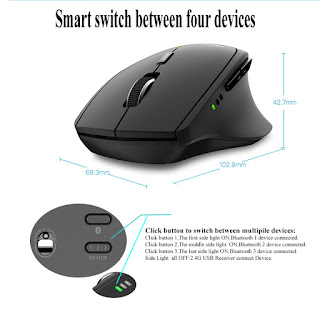
Connect Rapoo MT750S with Linux (Tested on Manjaro)

 I bought this obvious copy of MX Master 2S in hopes of having the device switching functionality along with a lightweight body because I ha...