Showing posts with label Easy. Show all posts

Friday, November 11, 2011

[UVa] 532 - Dungeon Master

With this, I get inside the first 1000 coders on UVa. :)
Submission details:
Submission no: 9461491
Problem no: 532 
Problem title: Dungeon Master
Status: Accepted
Language: C++
Runtime: 0.012
Date of submission: 2011-11-11
Time of submission: 11:12:39

#include <cstdio>
#include <cstring>
#include <algorithm>
#include <iostream>
#include <queue>
#define INF 9999999
using namespace std;

typedef struct xp
{
    int l, x, y;
} cord;

bool color[100][100][100];
int d[100][100][100];
char inp[100][100][100];

int dirs[10][4]={ {-1,0,0}, {1,0,0}, {0,-1,0}, {0,0,-1}, {0,0,1}, {0,1,0} };

int bfs(cord S, cord E, cord M)
{
    int i, j, k;

    for (i=0 ; i<=M.l+1 ; i++)
    {
        for (j=0 ; j<=M.x+1 ; j++)
        {
            for (k=0 ; k<=M.y+1 ; k++)
            {
                color[i][j][k]=false;
                d[i][j][k]=INF;
            }
        }
    }
    color[S.l][S.x][S.y]=true;
    d[S.l][S.x][S.y]=0;

    cord u, temp;

    queue<cord> q;
    q.push(S);
    while (!q.empty())
    {
        u = q.front();
        q.pop();

        for (i=0 ; i<6 ; i++)
        {
            temp.l = u.l+dirs[i][0];
            temp.x = u.x+dirs[i][1];
            temp.y = u.y+dirs[i][2];

            if (!color[temp.l][temp.x][temp.y] && inp[temp.l][temp.x][temp.y]!='#')
            {
                if (temp.l<1||temp.l>M.l||temp.x<1||temp.x>M.x||temp.y<1||temp.y>M.y)
                    continue;
                color[temp.l][temp.x][temp.y]=true;
                d[temp.l][temp.x][temp.y]=d[u.l][u.x][u.y]+1;
                if (i==E.l && j==E.x && k==E.y) return d[temp.l][temp.x][temp.y];
                    q.push(temp);
            }
        }
    }

    return d[E.l][E.x][E.y];
}


int main()
{
    int l, w, h, i, j, k, res;
    cord S, E, M;
    while (scanf("%d %d %d",&l,&h,&w)==3 && l&&h&&w)
    {
        getchar();

        M.l = l;
        M.x = h;
        M.y = w;

        for (i=1 ; i<=l ; i++)
        {
            for (j=1 ; j<=h ; j++)
            {
                gets(&inp[i][j][1]);
                for (k=1 ; k<=w ; k++)
                {
                    if (inp[i][j][k]=='S')
                    {
                        S.l = i;
                        S.x = j;
                        S.y = k;
                    }
                    if (inp[i][j][k]=='E')
                    {
                        E.l = i;
                        E.x = j;
                        E.y = k;
                    }
                }
            }
            gets(&inp[i][j][1]);
        }

        res = bfs(S,E,M);

        if (res==INF)
            printf("Trapped!\n");
        else
            printf("Escaped in %d minute(s).\n",res);
    }
    return 0;
}

Wednesday, October 26, 2011

[UVa] 11000 - Bee

This is all about careful reading and a very bit of analysis.
First analyze what happens with a Male bee. You'll see every year the number of bees in that tree is a Fibonacci number, since all the past bees are dead by then.
Then for a Female be, it's actually the same, because it gives birth to a Male bee the next year. And since the special bee produces one Male bee each year, so the result is actually the sum of Fibonacci numbers till n.

#include <iostream>
#include <cmath>
using namespace std;
long long sum[100], fibs[100];
int fib( ) {
    int i;
    long long lim = (long long)pow(2.00,32);

    fibs[0]=0LL; sum[0]=0LL;
    fibs[1]=1LL; sum[1]=1LL;
    fibs[2]=1LL; sum[2]=2LL;
    for (i=3 ; sum[i-1]<lim ; i++) {
        fibs[i]=fibs[i-1]+fibs[i-2];
        sum[i]=sum[i-1]+fibs[i];
    }

    return i;
}

int main( ) {
    fib();
    int n;
    while (cin >> n && n>=0)
    {
        cout << sum[n] << " " << sum[n+1] << endl;
    }
    return 0;
}

Tuesday, October 25, 2011

[UVa] 392 - Polynomial Showdown

Just conditioning, loads of ifs

If you're getting PE or WA just test with some isolated values for different coefficients. Some of my test cases are.
0    0    0    1   22 -333    0    1   -1
0    0    0    0    0    0  -55    5    0
0 0 0 0 0 0 0 0 0
0 0 0 0 0 0 0 0 -1
0 0 0 0 0 0 0 -1 0
0 0 0 0 0 0 -1 0 0
0 0 0 0 0 -1 0 0 0
0 0 0 0 -1 0 0 0 0
0 0 0 -1 0 0 0 0 0
0 0 -1 0 0 0 0 0 0
0 -1 0 0 0 0 0 0 0
-1 0 0 0 0 0 0 0 0
0 0 0 0 0 0 0 0 0
x^5 + 22x^4 - 333x^3 + x - 1
-55x^2 + 5x
0
-1
-x
-x^2
-x^3
-x^4
-x^5
-x^6
-x^7
-x^8
0


#include <stdio.h>
#include <string.h>

int a[10];

int main()
{
    int i, print, z;
    //freopen("input.txt","r+",stdin);
    //freopen("output.txt","w+",stdout);
    while (scanf("%d %d %d %d %d %d %d %d %d",&a[8],&a[7],&a[6],&a[5],&a[4],&a[3],&a[2],&a[1],&a[0])==9)
    {
        for (i=0, z=1 ; i<9 && z; i++)      //-----|Checking if the
            if (a[i]) z=0;                  //-----|polynomial is zero

        if (z) {                            //-----|The polynomial is found
            printf("0\n");                  //-----|to be zero in fact
            continue;
        }

    //-[ The first value of the equation is not printed yet ]
        print=0;
        for (i=8 ; i>1 ; i--)
        {
            if (print && a[i]) printf(" ");

            if (a[i]==-1)
            {
                (print? printf("- x^%d",i) : printf("-x^%d",i) );
            } else if (a[i]==1)
            {
                (print? printf("+ x^%d",i) : printf("x^%d",i) );
            } else if (a[i]<0)
            {
                (print? printf("- %dx^%d",-1*a[i],i) : printf("%dx^%d",a[i],i) );
            } else if (a[i])
            {
                (print? printf("+ %dx^%d",a[i],i) : printf("%dx^%d",a[i],i) );
            }
        //-- [ From the next time a space will seperate characters ]
            if(a[i]) print=1;
        }
        if (a[i])
        {
            if (print && a[i]) printf(" ");
            if (a[i]==-1)
            {
                (print? printf("- x") : printf("-x") );
            } else if (a[i]==1)
            {
                (print? printf("+ x") : printf("x") );
            } else if (a[i]<0)
            {
                (print? printf("- %dx",-1*a[i]) : printf("%dx",a[i]) );
            } else if (a[i])
            {
                (print? printf("+ %dx",a[i]) : printf("%dx",a[i]));
            }
        //-- [ From the next time a space will seperate characters ]
            if(a[i]) print=1;
        }
        i--;
        if (a[i])
        {
            if (print && a[i]) printf(" ");
            if (a[i]<0)
            {
                (print ? printf("- %d",-1*a[i]) : printf("%d",a[i]) );
            } else if (a[i])
            {
                (print ? printf("+ %d",a[i]) : printf("%d",a[i]) );
            }
        }

        printf("\n");
    }
    return 0;
}

Sunday, October 23, 2011

[UVa] 10190 - Divide but not quite conquer

Critical point:
If n<2 or m<2, it's "Boring!"
If at some point (n%m != 0), it's "Boring!" to the limit :P
Method:
I store the result in a string (char arrray) when the division is taking place. If the sequence is found to be not boring, print the string.

#include #include <stdio.h>
#include <string.h>

char output[1000000], temp[1000000];
int addStr(char *des, int val, int len)
{

    if (!len)
        sprintf(des,"%d",val);
    else
    {
        int i, j;
        sprintf(temp," %d",val);
        int ln = strlen(temp);
        for (i=len, j=0 ; j<ln ; i++, j++)
        {
            des[i]=temp[j];
        }
        des[i]='\0';
        return (len+j);
    }
    return strlen(des);
}

int main()
{
    int n, m;
    while (scanf("%d %d",&n,&m)==2)
    {
        int lnt = 0;
        int b=0;
        if (n<2 || m<2)
        {
            printf("Boring!\n");
            continue;
        }
        while (n>1)
        {
            lnt=addStr(output,n,lnt);
            if (n%m != 0)
                b=1;
            n/=m;
        }
        lnt=addStr(output,n,lnt);


        if (b)
            printf("Boring!\n");
        else
            printf("%s\n",output);
    }
    return 0;
}

[UVa] 11428 - A Minimum Land Price

#include <stdio.h>
#include <stdlib.h>
typedef long long ll;
ll pr(ll a, ll t)
{
    ll ret=1;
    while (t--)
        ret*=a;
    return ret;
}
ll a[100];
int cmp (const void *a, const void *b)
{
    return *(ll*)b-*(ll*)a;
}
int main()
{
    ll test, i, sum, j;
    scanf("%lld",&test);

    while (test--)
    {
        for (i=0 ; scanf("%lld",&a[i]) && a[i] ; i++);
        qsort(a,i,sizeof(ll),cmp);

        for (sum=0, j=0 ; j<i ; j++ )
        {
            sum += (pr(a[j],j+1));
        }
        sum *= 2;
        if (sum<=5000000)
            printf("%lld\n",sum);
        else
            printf("Too expensive\n");
    }
    return 0;
}

[UVa] 11830 - Contract Revision

#include <stdio.h>
#include <string.h>
char input[100000], pro[100000];
int rmv(char *a, char c)
{
    int i, z, len=strlen(a);

    for (i=0 ; i<len ; i++)
    {
        if (a[i]==c)
            a[i]='\\';
    }
    for (i=0, z=1 ; i<len ; i++)
    {
        if (a[i]!='0' && a[i]!='\\')
            z=0;
        if (!z && a[i]!='\\')
            putchar(a[i]);
    }

    if (z)
        printf("0");
    putchar('\n');
    return 0;
}

int main()
{
    char c;
    while (gets(input))
    {
        if (!strcmp("0 0",input))
            break;
        sscanf(input,"%c %s",&c,pro);

        rmv(pro,c);
    }
    return 0;
}

[UVa] 343 - What base is this?

I was too lazy when I saw this problem for the very first time 2 years ago. Solving problems that required parsing a string were too tedious for me back then. Well, guess what it generated a great code for future problems from this domain.

#include <stdio.h>
#include <math.h>
#include <string.h>
#define isChar(i) ((i>='A'&&i<='Z')||(i>='0'&&i<='9'))
typedef unsigned long long ULL;
int vals[1000];
char input[1000], val1[1000], val2[1000];
ULL getVal(char *a, int base, int ln)
{
    int len = ln, i;
    ULL val=0;
    for (i=len-1 ; i>=0 ; i--)
    {
        val = val + (vals[a[i]]) * (int)pow((double)base,(len-1-i));
    }
    return val;
}

int setVals()
{
    int i;
    for (i=0 ; i<=9 ; i++)
    {
        vals[i+'0'] = i;
    }
    for (i='A' ; i<='Z' ; i++)
    {
        vals[i] = (i-55);
    }
}

int parser(char *a, int *l1, int *l2, int *mb1, int *mb2)
{
    int i, j, min;
    for (i=0 ; !isChar(a[i]) ; i++);
    min=-1;
    for (j=0 ; isChar(a[i]) ; i++, j++)
    {
        val1[j]=a[i];
        if (vals[a[i]]>min)
            min = vals[a[i]];
    }
    val1[j]='\0';
    *l1=j;
    *mb1=min+1;

    for ( ; !isChar(a[i]) ; i++);
    min=-1;
    for (j=0 ; isChar(a[i]) ; i++, j++)
    {
        val2[j]=a[i];
        if (vals[a[i]]>min)
            min = vals[a[i]];
    }
    val2[j]='\0';
    *l2=j;
    *mb2=min+1;
}

int main()
{
    int l1, l2, minb1, minb2, f, i, j;
    setVals();

    while (gets(input))
    {
        parser(input,&l1,&l2,&minb1,&minb2);

        f=0;

        for (i=(minb1>1?minb1:2) ; i<=36 && !f ; i++)
        {
            for (j=(minb2>1?minb2:2) ; j<=36 && !f ; j++)
            {
                if (getVal(val1,i,l1) == getVal(val2,j,l2))
                {
                    printf("%s (base %d) = %s (base %d)\n",val1,i,val2,j);
                    f=1;
                }
            }
        }

        if (!f) printf("%s is not equal to %s in any base 2..36\n",val1,val2);

    }
    return 0;
}

Saturday, October 22, 2011

[UVa] 11850 - Alaska

With this, I finish 300 solves in UVa. :) Took too long.
My stats at the moment:
Submissions: 1701
Problems tried: 322
Problems solved: 300
First submission: 2009-11-17
Last submission: 2011-10-21
And details on the last submission:
Problem number: 11850
Rank of solution: 225
Submission number: 9395891
Date: 2011-10-21
Time: 20:54:39
Runtime: 0.008

Method:
1. Take the input and sort the array.
2. Check if between two consecutive stations the distance is > 200. If so IMPOSSIBLE
3. At last she has to go to the destination and come back to the last station, so check if (1422-[last station])X2 > 200.

#include <stdio.h>
#include <stdlib.h>

int cmp(const void *a, const void *b)
{
    return (*(int*)a - *(int*)b);
}
int miles[4000];
int main()
{
    int n, i, set;
    while (scanf("%d",&n) && n)
    {
        for (i=0 ; i<n ; i++)
            scanf("%d",&miles[i]);
        qsort(miles,n,sizeof(int),cmp);
        set=1;

        for (i=1 ; i<n && set ; i++)
        {
            if (miles[i]-miles[i-1]>200) set=0;
        }
        if (2*(1422-miles[n-1])>200) set=0;
        if (set) printf("POSSIBLE\n");
        else printf("IMPOSSIBLE\n");
    }
    return 0;
}

[UVa] 10432 - Polygon inside a circle

#include <stdio.h>
#include <math.h>
#define PI (2*acos(0))
int main()
{
    double area, r, n;
    while (scanf("%lf %lf",&r,&n)==2)
    {
        area = r*r*sin(2*PI/n)/2.0;
        printf("%.3lf\n",area*n);
    }
    return 0;
}

[UVa] 374 - Big Mod

Used a recursive method from Art of Programming Contest
LL bigMod(LL b, LL p, LL m)
{
    if (!p) return 1;
    else if (!(p&0x01)) return power(bigMod(b,p/2,m),2)%m;
    else return (b%m * bigMod(b,p-1,m))%m;
}

#include <stdio.h>
#define LL long
LL power(LL a, LL p)
{
    int ret=1;
    while (p--)
        ret*=a;
    return ret;
}
LL bigMod(LL b, LL p, LL m)
{
    if (!p) return 1;
    else if (!(p&0x01)) return power(bigMod(b,p/2,m),2)%m;
    else return (b%m * bigMod(b,p-1,m))%m;
}

int main()
{
    LL b, p, m;
    while (scanf("%ld %ld %ld",&b,&p,&m)==3)
    {
       printf("%ld\n",bigMod(b,p,m));
    }
    return 0;
}

Friday, October 21, 2011

[UVa] 11650 - Mirror Clock

Nice and fun! The only tricky case probably is a time that generated 0 hours, just make it 12 but keep the minute same. I don't know if handling for 24 hours time is needed but added that too.
#include <stdio.h>

int main()
{
    int tst, h, m, time;
    scanf("%d",&tst);
    while (tst--)
    {
        scanf("%d:%d",&h,&m);
        time = h*60 + m;
        if (time>720) time-=720;
        time = 720-time;

        h = (time/60);
        m = time%60;

        if (!h) h = 12;

        if (h<10)
            printf("0%d:",h);
        else
            printf("%d:",h);
        if (m<10)
            printf("0%d\n",m);
        else
            printf("%d\n",m);
    }
    return 0;
}

[UVa] 10550 - Combination Lock

#include <stdio.h>

/* Guilty by association */

int main()
{
    int i, a, b, c, deg;
    while (scanf("%d %d %d %d",&i,&a,&b,&c)==4)
    {
        if (!i && !a && !b && !c) break;

        deg = 720+360 + (((a>i?(40-a)+i:(i-a)) + (b<a?(40-a)+b:(b-a)) + (c>b?(40-c)+b:(b-c))))*9;

        printf("%d\n",deg);
    }
    return 0;
}

Thursday, October 20, 2011

[UVa] 455 - Periodic Strings

#include <stdio.h>
#include <string.h>
char input[10000];
int finder(char *a)
{
    int len = strlen(a), l, v, i, j;
    char q[100];

    for (l=1 ; l<=(len/2) ; l++)
    {
        for (i=0 ; i<l ; i++)
        {
            q[i]=a[i];
        }
        q[i]='\0';
        v=1;
        for (i=0 ; i<len && v ; i+=l)
        {
            for (j=0 ; j<l && v ; j++)
            {
                if (q[j]!=a[i+j]) v=0;
            }
        }
        if (v) return l;
    }
    return len;

}
int main()
{
    int test, kase=1;
    scanf("%d",&test);
    getchar();
    while (test--)
    {
        gets(input);
        gets(input);
        if (kase++>1) printf("\n");
        printf("%d\n",finder(input));

    }
    return 0;
}

Monday, October 17, 2011

[UVa] 438 - The Circumference of the Circle

Just use the formula here: Circumcenter

#include <stdio.h>
#include <math.h>
#define dis(x1,y1,x2,y2) sqrt(fabs((x1-x2)*(x1-x2)+(y1-y2)*(y1-y2)))
#define PI 3.141592653589793
double area(double x1, double y1, double x2, double y2, double x3, double y3)
{
    double a = dis(x1,y1,x2,y2);
    double b = dis(x2,y2,x3,y3);
    double c = dis(x3,y3,x1,y1);


    double s = (a+b+c)/2.0;
    double r = (a*b*c)/sqrt(s*(s-a)*(s-b)*(s-c))/2.0/2.0;
    return (2.0*PI*r);
}

int main()
{
    double x1,y1,x2,y2,x3,y3;

    while (scanf("%lf %lf %lf %lf %lf %lf",&x1,&y1,&x2,&y2,&x3,&y3)==6)
    {
        printf("%.2lf\n",area(x1,y1,x2,y2,x3,y3));
    }
    return 0;
}

[UVa] 278 - Chess

Analyze all 4 cases and soon you'll equations for all of them. The given advantage is the lower limit of 4. Below that the derived theorems fail.

#include <stdio.h>
#include <string.h>
#define min(a,b) (a<b?a:b)
char inp[100];
int main()
{
    int test, x, y;
    char a;
    scanf("%d",&test);
    getchar();
    while (test--)
    {
        gets(inp);


        sscanf(inp,"%c %d %d",&a,&x,&y);
        if (a=='k')
        {
            printf("%d\n",(x*y+1)/2);
        } else if (a=='K')
        {
            printf("%d\n",((x+1)/2) * ((y+1)/2));
        } else if (a=='Q'||a=='r')
        {
            printf("%d\n",min(x,y));
        }
    }
    return 0;
}

[UVa] 12289 - One-Two-Three

Any efficient you know about? :(

#include <stdio.h>
#include <string.h>

int tester(char *in)
{
    int len = strlen(in), i, f1, f2, f3;

    if (len == 3)
    {
        char one[]="one", two[]="two";
        for (i=0, f1=0, f2=0 ; i<3 ; i++)
        {
            if (one[i]!=in[i]) f1++;
            if (two[i]!=in[i]) f2++;
        }
        if (f1<2) return 1;
        if (f2<2) return 2;

    } else if (len == 5)
    {
        char three[]="three";
        for (i=0, f3=0 ; i<5 ; i++)
        {
            if (three[i]!=in[i]) f3++;
        }
        if (f3<2) return 3;
    }
    return 0;
}

int main()
{
    int test, res;
    char input[100];

    scanf("%d",&test);

    while (test--)
    {
        scanf("%s",input);
        res = tester(input);
        printf("%d\n",res);
    }
    return 0;
}

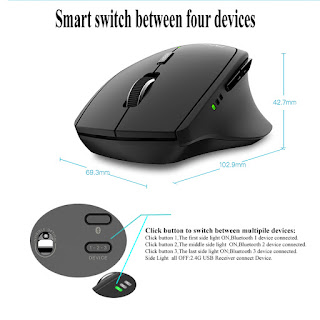
Connect Rapoo MT750S with Linux (Tested on Manjaro)

 I bought this obvious copy of MX Master 2S in hopes of having the device switching functionality along with a lightweight body because I ha...